
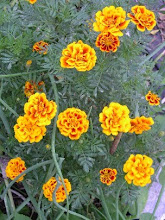

High Plains - Photo by David Nance
For longer than I care to think about I have been reading Eventide, by Kent Haruf. It's not a long book, so I don't exactly know why it took me so long to read. Maybe it's because I had a hard time with it for about half the book, thought I didn't even like it, kept reading out of that strange sense of duty I often feel to finish a book, and because G. liked it so much. I read it without knowing that it is a sequel to Plainsong, but I don't think that mattered very much to this reading. Now I am so glad that I persevered - this is a deeply human, lovely book. Here is a review from the Denver Post - I thought that the best understanding of this story might come from someone who lives close to its setting, which is the High Plains of eastern Colorado. It's a glowing review, and I am in total agreement with its every word. My next library trip will be to pick up a copy of Plainsong, and find out how Victoria Roubideaux came to stay with the McPheron brothers.
The novel roams over Holt, a small rural town, the ranching country that surrounds it, and the lives of a group of people who live in these places, much as a movie camera roams from shot to shot. In fact, G and I both thought that it would make a wonderful movie, in much the same vein as The Last Picture Show, though it's told in a much kinder and gentler tone. (There is much description of landscape, weather, details of life with cattle, including a dreadful scene of a bull gone out of control.) It has the same feel of open, dry, bleak, but somehow beautiful (okay, yes, I find the dry open bleak spaces of West Texas beautiful, you wanna make something of it?) spaces, sky, the smallness of human life in this setting. The smallness, but at the same time infinite preciousness. The story weaves many characters' lives together, tells their stories in a slow rambling web that is much like life itself. Somehow, when I was having trouble with the book, all I could see was the bleakness of many of their stories - the children in particular broke my heart, filled me with desolation. There is kindness abounding however, and love, and goodness - and these elements reach out to fill much of the emptiness.
A little bit of what I mean about the landscape, in this passage from a chapter late in the book:
"They drove on and passed through Holt and went west on US 34. The highway stretched out before them, lined on both sides by the shallow barrow ditches. Above the ditches the four-strand barbed-wire fences ran along beside the pastures in the flat sandy country, and above the fences the line of telephone poles rose up out of the ground like truncated trees strung together with black wire. Hoyt rode with him through Norka and as far as Brush. Then he got another ride and traveled on, headed west on a Monday morning in spring."
Another passage I love - with a little explication first: DJ is a lonely 11 year old orphan, living with his grandfather. He has finally made a deep friendship with another child, a girl named Dena. Dena's mother is moving the family two hours distance away, and the children have just said their goodbyes. DJ returns to the shack that he and Dena have made their own private clubhouse to make his real goodbye to what they have shared together:
"The little wooden shed was dim and filled with shadows. He lit one of the candles and sat down at the table, looking around at the dark back wall and the shelf. The candlelight was flickering and dancing on the walls. There was little to see. The framed picture of the baby Jesus hanging on the wall. Some of their board games. Old plates and pieces of silverware in a box. It didn't feel good in the shed without her. Nothing there was the same. He whistled through his teeth, softly, a tune he thought of. Then he stopped. He stood and blew out the candle and went outside and fastened the latch. He stood looking for a long time at the old abandoned house across the backyard grown up in weeds, the old black Desoto rusting among the bushes. Then he entered the alley once more. His grandfather would be waiting. It was already past the hour at which his grandfather wanted his supper."

2 comments:
Beautiful.
V
Oh, this sounds like a lovely book. Thank you for pointing it out to us.
Post a Comment